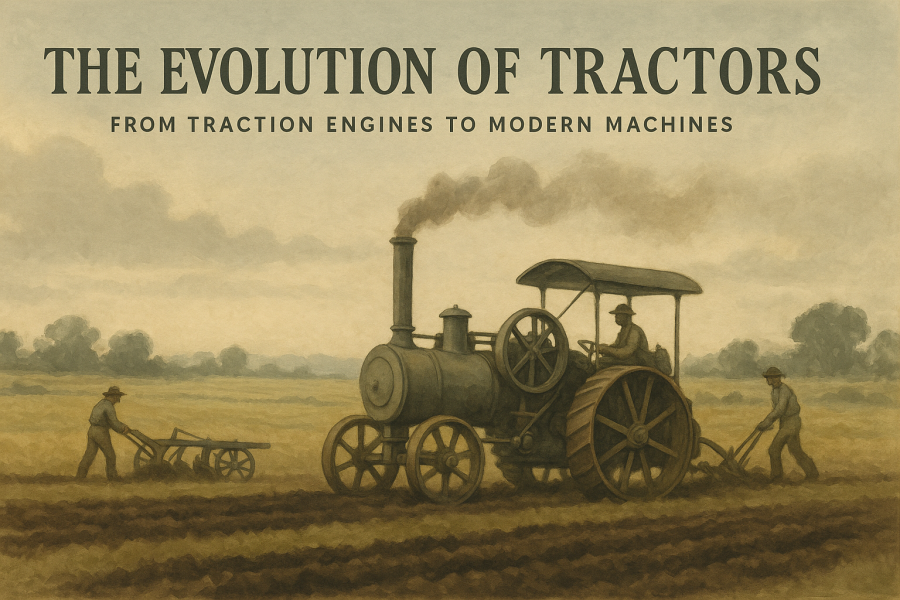
The Decline of Steam Power in Agriculture
Steam power transformed farming but was overtaken by internal combustion engines in the early 20th century.
Steam tractors and traction engines were extensively used in agriculture until the early 20th century, when internal combustion engines began to dominate the market.
When Steam Ruled the Fields: The Rise and Fall of the Agricultural Traction Engine
Before diesel engines, hydraulic systems and modern tractors, agriculture relied on enormous iron machines that hissed, smoked and shook the ground. For several decades, steam power represented the future of farming. Then, almost as quickly as it had arrived, its dominance began to disappear.
Imagine standing beside a field in the English countryside in 1890. The harvest is underway, and somewhere beyond the hedgerow, a tall chimney sends a column of smoke into the summer sky. There is a steady mechanical rhythm, interrupted by the occasional whistle and the sharp sound of steam escaping under pressure.
At the edge of the field stands a traction engine. Its enormous iron wheels rest on the earth, while a long leather belt connects its flywheel to a threshing machine. Men feed sheaves of grain into the equipment as others collect the separated straw.
The engine itself barely moves.
Yet it is doing the work that once required substantial numbers of people and animals.
This was the agricultural revolution brought about by steam power. It did not begin with the familiar tractor pulling a plough across a field. Instead, it began with machines that could transport themselves between farms and provide mechanical power wherever it was needed.
For much of the nineteenth century, that was revolutionary enough.
Before Steam: Farming at the Speed of a Horse
For centuries, the pace of agricultural work was determined by the strength of people and draught animals.
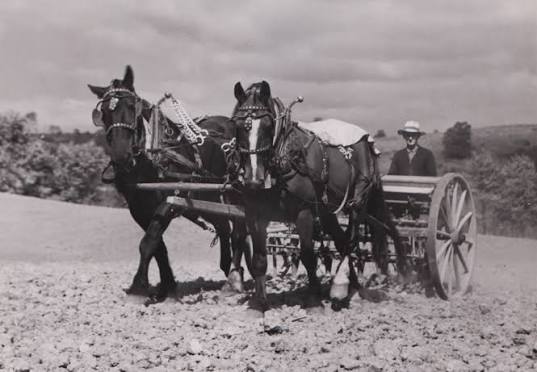
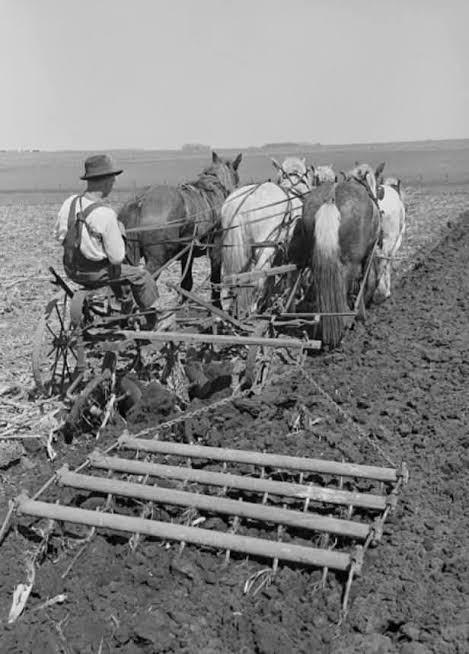
Horses and oxen pulled ploughs, carts and harvesting equipment. Threshing grain required considerable manual labour, while larger farms sometimes relied on stationary machinery driven by horses walking in circles.
As agricultural production expanded during the nineteenth century, these methods became increasingly restrictive.
A farm could employ more workers or maintain additional animals, but both approaches involved substantial costs. Horses required feed, shelter and care throughout the year, regardless of how many days they were actually needed for fieldwork.
Steam engines offered a different possibility.
Industrial steam power was already transforming factories, mines and transport. Engineers began adapting the same principles to agriculture, initially by developing stationary engines that could drive threshing machines and other equipment.
The problem was moving them.
Early portable engines could be hauled between locations, but they could not travel under their own power. Moving a heavy boiler and engine from one farm to another still required horses.
The next logical development was to make the engine self-propelled.
The Traction Engine Arrives
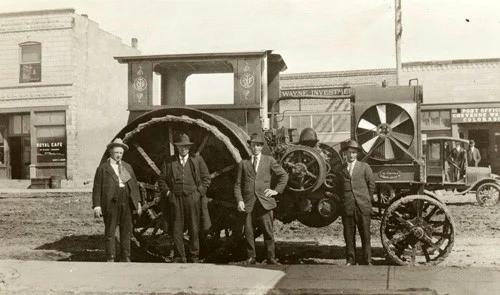
By the middle of the nineteenth century, British engineers were developing practical self-propelled steam engines capable of travelling on roads and working in agricultural environments.
The traction engine was not the invention of a single person or company. It emerged through decades of experimentation with steam boilers, gearing, wheels and propulsion systems.
Among the important pioneers was Thomas Aveling, whose work helped establish the self-propelled traction engine as a commercially practical machine during the 1860s.
His company, Aveling & Porter, became one of the most recognised British traction-engine manufacturers.
Other firms, including Charles Burrell & Sons, John Fowler & Co., Richard Garrett & Sons and Marshall, Sons & Co., also became important names in the industry.
Although their machines differed in design, they shared a familiar appearance.
A large horizontal boiler formed the main body. A tall chimney rose from the front. The engine and flywheel were generally mounted above or beside the boiler, while enormous rear driving wheels transmitted power to the ground.
The driver stood on a platform at the rear, controlling the regulator, steering and other mechanisms.
These were not small machines.
Depending on their purpose, traction engines could weigh many tonnes and required considerable skill to operate safely.
But their size was also part of their appeal. They could generate sustained mechanical power for demanding tasks that would otherwise require significant animal or human labour.
The Engine That Worked Without Moving
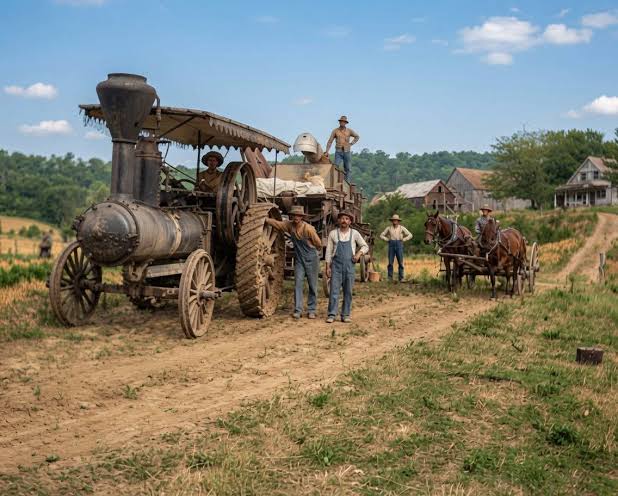
One of the most important uses of agricultural traction engines was stationary power generation.
A traction engine could travel to a farm, position itself beside a threshing machine, and use a long leather belt to transmit power from its flywheel.
The engine remained stationary while the machinery performed the work.
Threshing was particularly important because separating grain from harvested crops had traditionally been labour-intensive.
With a steam-powered threshing machine, large quantities of grain could be processed far more efficiently than by hand.
The arrangement also had a commercial advantage.
Not every farmer needed to own an expensive steam engine.
Specialist contractors could travel between farms, offering threshing and other machinery services during the agricultural season.
A single traction engine might serve numerous customers, moving from village to village with its accompanying equipment.
The arrival of a threshing contractor became a significant event in rural communities. The machinery was noisy, complicated and potentially dangerous, but it could dramatically reduce the time required to process a harvest.
Steam power was changing the economics of agriculture even before it became practical to pull a plough directly across a field.
Why Ploughing Was More Complicated
If a traction engine could haul heavy loads along a road, it might seem reasonable to assume that it could simply pull a plough across a field.
In practice, things were more difficult.
Traction engines were extremely heavy, and their iron wheels could struggle on wet or soft ground.
Their weight increased soil compaction, while their limited manoeuvrability made fieldwork challenging.
British engineers developed an ingenious solution: cable ploughing.
Rather than driving the engine across the field, the system used steam power to pull the plough by means of a steel cable.
One common arrangement employed two powerful ploughing engines positioned on opposite sides of a field.
A cable stretched between them, and the engines alternately wound the ploughing implement back and forth.
The engines could remain on firmer ground while the implement travelled across the cultivated area.
John Fowler & Co. became especially associated with the development and commercial success of steam cable-ploughing systems.
These systems could be highly effective on large estates and in suitable agricultural conditions.
However, they required expensive machinery, skilled operators and considerable preparation.
For smaller farms, the economics were often difficult to justify.
Steam ploughing was an impressive technical achievement, but it was not a universal solution.
Across the Atlantic: America’s Giant Steam Tractors
While British engineers developed sophisticated cable-ploughing systems, agricultural steam power followed a somewhat different path in North America.
American and Canadian farms often operated across much larger areas, particularly in the wheat-growing regions of the Great Plains and Canadian Prairies.
The landscape encouraged the development of powerful steam engines designed for heavy agricultural work.
Manufacturers such as J. I. Case, Advance-Rumely and Minneapolis Threshing Machine Company became prominent names in the North American steam era.
Some of their engines were enormous, built to haul heavy equipment and operate large threshing outfits.
American steam tractors also developed features suited to local conditions.
On farms where straw was readily available, some engines were designed or adapted to burn it as fuel. This could reduce dependence on coal, although maintaining a reliable fire and sufficient steam pressure still required considerable attention.
The machines were impressive, but they were demanding.
Operating a steam tractor required more than steering and opening a throttle.
The crew had to manage boiler pressure, water levels, lubrication, fuel and the mechanical condition of the engine.
A poorly maintained boiler could be extremely dangerous.
The operator needed to understand the machine rather than simply drive it.
A Working Day with a Steam Engine
Starting a steam traction engine was not a matter of turning a key.
Before work could begin, the crew needed to inspect the machine, confirm the boiler contained sufficient water, prepare the fire and gradually raise steam pressure.
Depending on the engine and conditions, this preparation could take considerable time.
Once operating, the engine required constant attention.
Fuel had to be supplied to the firebox, water levels monitored, and moving components lubricated.
The machinery was exposed, and the operator worked close to hot surfaces, rotating shafts, belts and gears.
There was little resemblance to the enclosed, climate-controlled cabs found on modern agricultural tractors.
The work could be physically exhausting, especially during long harvesting days.
Yet experienced operators developed a remarkable familiarity with their engines.
They learned to recognise changes in mechanical sound, variations in steam pressure and the behaviour of the machinery under load.
A skilled engine driver could make an enormous difference to the reliability and productivity of an agricultural operation.
Steam power was as much about the people operating the machinery as it was about the machinery itself.
The Smaller Steam Tractor
In Britain, the term steam tractor also acquired a more specific meaning.
It commonly referred to a relatively small traction engine intended for lighter road haulage, often within the weight limits established by contemporary legislation.
These machines were generally smaller than full-sized road locomotives and heavy agricultural traction engines.
They could pull wagons and transport goods while being more practical for certain commercial applications.
Although they shared many mechanical principles with larger traction engines, their size and intended purpose distinguished them.
This historical terminology can cause confusion today.
In North America, the term steam tractor is frequently used more broadly for agricultural steam engines.
In Britain, collectors and historians often maintain clearer distinctions between agricultural traction engines, steam tractors, road locomotives and ploughing engines.
Understanding these differences helps explain why two steam-powered machines that look similar may have been designed for very different jobs.
The Arrival of the Gasoline Tractor
By the late nineteenth century, engineers were already experimenting with internal combustion engines for agricultural machinery.
One of the important early developments came in the United States, where John Froelich built a successful gasoline-powered traction engine in 1892.
Although commercial adoption took time, the concept demonstrated that agricultural machinery did not necessarily require a boiler, a firebox and a supply of water.
Internal combustion engines offered several potential advantages.
They could be started more quickly, required fewer operating preparations and could be installed in more compact machines.
As engine technology improved, tractors became lighter and more manoeuvrable.
Manufacturers such as Hart-Parr, International Harvester and Ford helped establish the gasoline-powered tractor as a practical alternative to steam.
The introduction of the Fordson Model F in 1917 was particularly significant.
Ford’s manufacturing methods helped make tractors more affordable to a broader range of farmers.
Although early gasoline tractors had their own mechanical limitations, they were increasingly attractive compared with the expense and complexity of steam machinery.
The balance was beginning to shift.
Why Steam Lost the Battle
Steam engines did not disappear because they suddenly stopped working.
Many remained powerful, reliable machines when properly maintained.
Their problem was that newer tractors increasingly offered a better combination of convenience, cost and versatility.
A farmer operating a gasoline or later diesel tractor did not need to raise steam before starting work.
There was no boiler requiring constant water-level management, and routine operation generally required fewer specialised skills.
Internal combustion tractors could also be better suited to smaller fields and mixed agricultural work.
As production increased, prices became more competitive and spare-parts networks expanded.
The economic advantages of steam gradually weakened.
The transition was not immediate.
Some steam engines continued working for decades, particularly in threshing, road haulage and specialised applications.
In Britain, commercial use survived in certain sectors well into the twentieth century, with some machines remaining active into the 1950s.
But the direction of agricultural mechanisation had become clear.
The future belonged to the internal combustion tractor.
The Machines That Refused to Disappear
The decline of steam power did not mean the disappearance of steam engines themselves.
Across Britain, North America and other parts of the world, enthusiasts began preserving machines that had once been ordinary working equipment.
Some engines were rescued from scrapyards. Others survived in barns, workshops or private collections.
Restoration could require years of work.
Boilers needed careful inspection and sometimes major repairs. Worn mechanical components had to be rebuilt, and missing parts recreated.
But the effort preserved an important chapter of engineering history.
Today, steam rallies and agricultural heritage events allow visitors to experience these machines in operation.
A restored traction engine is more than a static museum exhibit.
When its fire is burning, its flywheel turning and steam rising from the chimney, it becomes possible to understand why these machines once inspired such admiration.
Their movement is slow, deliberate and unmistakably mechanical.
Unlike many modern machines, much of their operation is visible.
You can watch the connecting rods move, hear the exhaust beats and see the enormous gears transferring power to the wheels.
For machinery enthusiasts, that mechanical honesty is a large part of their appeal.
What Steam Power Left Behind
The steam era introduced principles that continued to influence agricultural mechanisation long after the last commercial traction engines were retired.
It demonstrated the value of mobile mechanical power.
It encouraged the development of agricultural contracting, allowing expensive machinery to serve multiple farms.
It accelerated the mechanisation of threshing, ploughing and transport.
And it helped establish the idea that agricultural productivity could be transformed through engineering rather than simply by increasing the number of workers or draught animals.
The modern tractor is fundamentally different from a Victorian traction engine.
Its engine, transmission, hydraulics, electronics and operator environment would be almost unrecognisable to a nineteenth-century driver.
But both machines were built around the same essential ambition: providing mechanical power where farmers needed it.
The steam traction engine was one of the first practical demonstrations of that idea on a large scale.
It was heavy, complicated, thirsty and demanding.
It also helped change farming forever.
And more than a century later, the sound of a steam whistle rising over a field still reminds us where agricultural mechanisation began.
Tractorholics Historical Feature — Agricultural Steam Power and Traction Engines
Sources
- Traction engine (Wikipedia) retrieved 13 Oct 2026
- Steam tractor (Wikipedia) retrieved 13 Oct 2026
- Portable engine (Wikipedia) retrieved 13 Oct 2026
Read next