John Deere Waterloo Boy Silver 1:16 – 100th Anniversary
The Silver Waterloo Boy: Inside the Rare John Deere 100th Anniversary 1:16 Scale Tractor
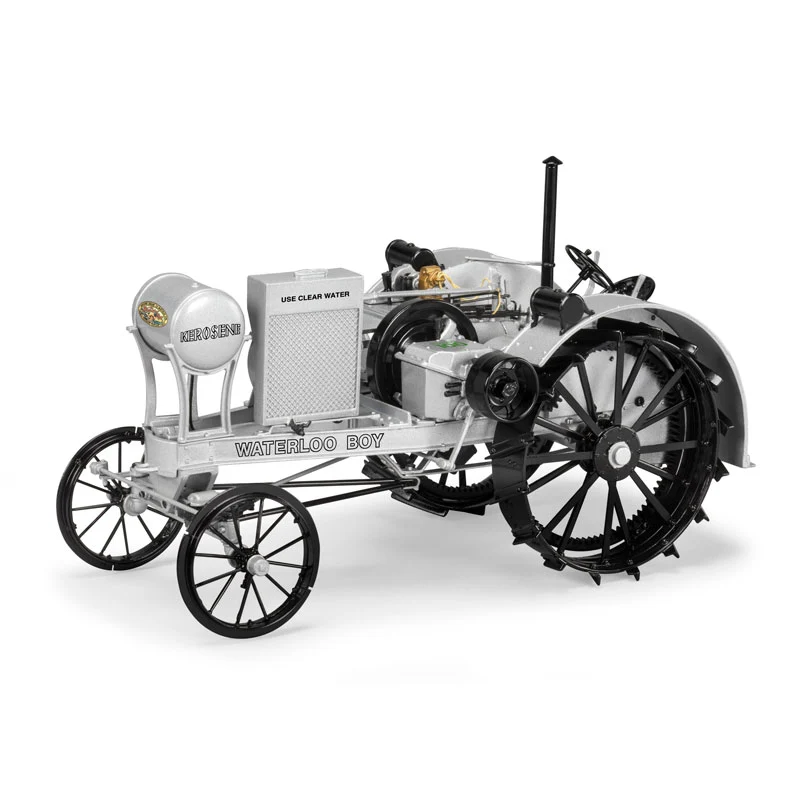
One hundred years after John Deere entered the tractor business, ERTL recreated the machine that started it all. Finished in commemorative silver and produced for collectors, the 1:16 scale Waterloo Boy Precision tractor is a miniature tribute to one of the most important acquisitions in agricultural history.
There is something wonderfully unexpected about seeing a Waterloo Boy tractor in silver.
For most agricultural machinery enthusiasts, the name John Deere immediately brings to mind green paint and yellow wheels. Those colours have become so familiar that it is almost impossible to imagine the brand any other way.
But this particular Waterloo Boy model was never intended to look ordinary.
Released in 2018 to celebrate 100 years of John Deere tractor manufacturing, the silver 1:16 scale Waterloo Boy Precision tractor pays tribute to a moment that helped shape the future of American agriculture.
It is a collectible with a story much bigger than its dimensions.
The model represents the Waterloo Boy Model N, a tractor from the era when gasoline and kerosene-powered agricultural machines were beginning to replace steam engines and horse-drawn equipment.
Its unusual silver finish commemorates the year 1918, when Deere & Company purchased the Waterloo Gasoline Engine Company in Waterloo, Iowa.
That acquisition would eventually transform John Deere into one of the world’s best-known tractor manufacturers.
A century later, ERTL brought the story back to collectors’ shelves.
A Silver Tractor with a Hundred Years of History
In March 1918, Deere & Company made a decision that would change the direction of its business.
Although Deere was already an established manufacturer of agricultural implements, the company needed a stronger position in the growing market for motorised tractors.
Rather than starting entirely from scratch, it acquired the Waterloo Gasoline Engine Company.
The purchase brought the Waterloo Boy tractor into the John Deere business and provided manufacturing experience, engineering knowledge, and an established tractor product.
The Waterloo Boy was not a sophisticated machine by modern standards.
It belonged to a generation of tractors built around exposed mechanical components, steel wheels, simple controls, and the practical need to replace animal power.
But it represented a major change in the way farmers could work.
The tractor made it possible to provide sustained mechanical power without relying on a team of horses.
For John Deere, the Waterloo acquisition was the beginning of an industrial journey that would eventually lead to machines such as the Model D, the 4020, and today’s electronically controlled agricultural tractors.
The 2018 silver Waterloo Boy model celebrates that beginning.
It is not simply a miniature old tractor painted in a different colour. It represents a specific anniversary in the history of the company.
The 2018 ERTL Waterloo Boy Precision Anniversary Edition
ERTL, a name familiar to generations of farm toy collectors, produced the Waterloo Boy anniversary model as part of a wider commemorative programme.
The series celebrated John Deere’s first century in tractor manufacturing with specially finished models representing different generations of machinery.
Among them, the Waterloo Boy was an obvious choice.
It was the tractor that connected the anniversary directly to 1918.
The 1:16 scale Precision version was developed for collectors who appreciate larger models and detailed reproductions of historic agricultural equipment.
Its commemorative silver-and-black colour scheme immediately distinguishes it from conventional Waterloo Boy replicas.
The unusual finish creates an interesting contrast with the machine’s early twentieth-century design.
Its mechanical form belongs to the pioneering era of tractor manufacturing, while its appearance celebrates a milestone reached a century later.
For a collector, that contrast is the attraction.
Why the 1:16 Scale Matters
Farm toy collectors have several popular scales to choose from, including 1:64, 1:32, and 1:16.
The 1:16 scale is particularly appealing for historic tractors because it provides enough physical size to make the machinery’s construction a central part of the display.
At this scale, one inch on the model represents sixteen inches on the full-sized machine.
That makes it easier to appreciate the characteristic proportions of an early tractor.
The Waterloo Boy’s exposed engine arrangement, large rear driving wheels, narrow front end, and upright operator position tell a story about how tractors were designed before enclosed cabs, advanced transmissions, and hydraulic systems became commonplace.
Unlike a modern tractor, where much of the engineering is hidden beneath body panels, the Waterloo Boy’s mechanical architecture is a major part of its appearance.
That makes it an especially interesting subject for a detailed collectible.
ERTL’s Precision range is intended to offer a higher level of model detail than basic farm toys, making the Waterloo Boy particularly suitable for collectors interested in agricultural engineering history.
Limited to 2,018 Pieces: The Meaning Behind the Number
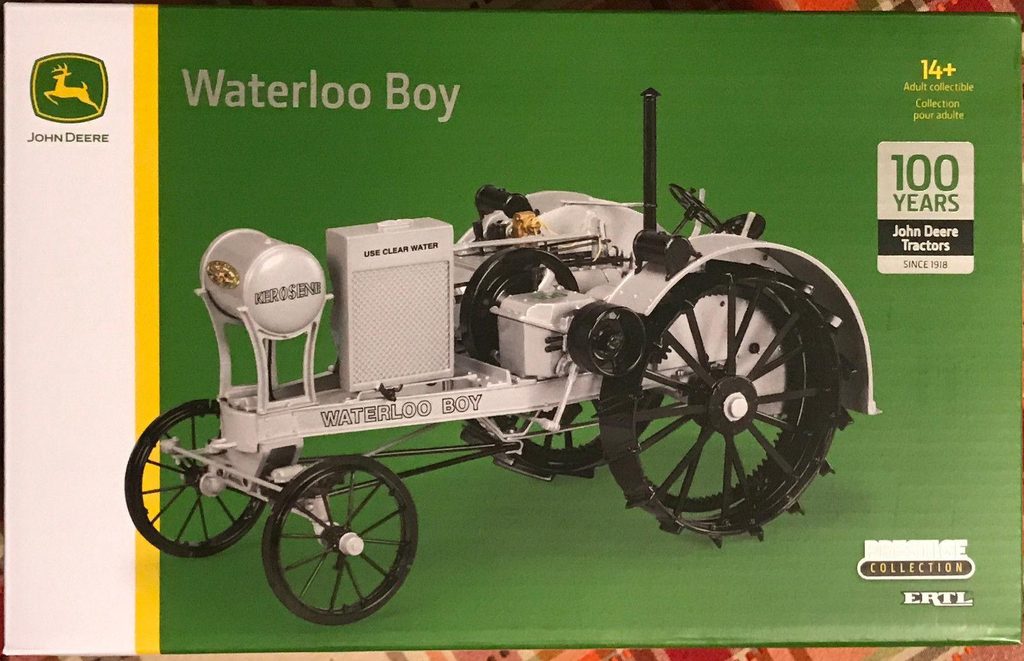
The anniversary edition has another feature that makes it attractive to collectors: its limited production.
ERTL announced a production quantity of 2,018 pieces for the 1:16 Precision Waterloo Boy anniversary model.
The number was not arbitrary.
It referenced the centennial year itself.
This gave the model a direct connection to the 1918–2018 anniversary and differentiated it from regular-production Waterloo Boy replicas.
Limited production is important in the collectible tractor market, but it should be understood carefully.
A limited edition is not automatically valuable simply because relatively few examples were produced.
Condition, packaging, collector demand, authenticity, and the specific version all influence its desirability.
For the silver Waterloo Boy, the combination of an important historical subject, commemorative finish, ERTL Precision construction, and documented production limit provides a particularly strong collector story.
Standard Anniversary Release vs. Special Edition
One detail worth checking before purchasing is the exact version being offered.
The retailer Dalton’s Farm Toys identifies a silver Waterloo Boy Precision anniversary model as well as a separately listed special-edition variant.
These listings carry different stock numbers and prices.
That matters because collectors often distinguish between versions based on packaging, distribution, edition markings, and other details that may not be immediately apparent in a photograph of the tractor alone.
A buyer should therefore verify the product number, original box, included documentation, and any special-edition markings before assuming two silver Waterloo Boy models are identical.
For serious collectors, the packaging and documentation can be almost as important as the model itself.
What Makes the Waterloo Boy Such a Special Tractor?
The Waterloo Boy occupies a distinctive place in John Deere history.
Its origins lie in the early development of gasoline-powered agricultural machinery, when manufacturers were experimenting with designs capable of replacing steam engines and horses.
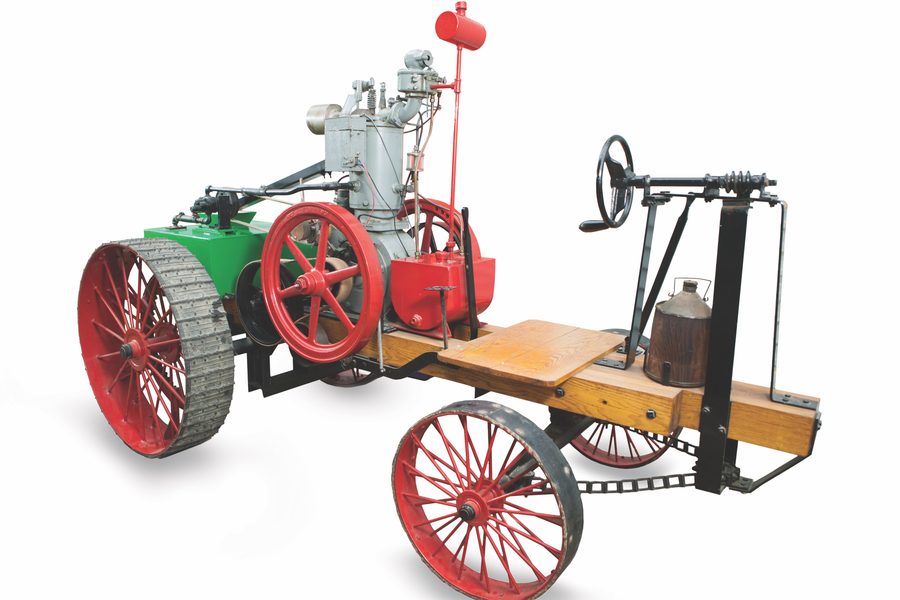
The Waterloo company’s roots can be traced to the pioneering work of John Froelich, who developed a successful gasoline-powered agricultural traction machine in 1892.
Froelich’s original tractor did not achieve commercial success, and the company subsequently concentrated on stationary engines.
But the business survived and eventually returned to tractor manufacturing.
The Waterloo Boy emerged from that later period of development.
By the time John Deere acquired the company in 1918, gasoline and kerosene tractors were becoming increasingly practical for farmers.
The Waterloo Boy helped John Deere establish itself in this expanding market.
The company later introduced the Model D in 1923, beginning another important chapter in its tractor history.
That is why a Waterloo Boy collectible carries more historical significance than its modest appearance might suggest.
It represents the bridge between an experimental age and the beginning of John Deere’s tractor manufacturing tradition.
The Silver Finish: A Collector’s Conversation Piece
A silver Waterloo Boy looks unusual because the original tractor was never known for this commemorative appearance.
That is precisely the point.
The silver finish is not intended as a conventional factory-colour restoration of the full-sized machine.
It is a visual celebration of the anniversary.
Displayed alongside green-and-yellow John Deere models, the silver Waterloo Boy creates an immediate focal point.
Its historical shape contrasts with modern machines, while the metallic finish separates it from standard historic tractor reproductions.
For collectors who organise their displays chronologically, the model can serve as a natural starting point for a John Deere tractor timeline.
Place it beside a Model D, a two-cylinder Model A, a New Generation 4020, and a modern John Deere tractor, and the development of agricultural engineering becomes visible in miniature.
That is one of the pleasures of collecting farm models.
A carefully chosen group of tractors can tell the story of an entire industry without a single full-sized machine.
Is the Silver Waterloo Boy Worth Collecting?
For collectors interested in John Deere history, the silver Waterloo Boy has several qualities that make it particularly appealing.
First, it commemorates a clearly defined historical milestone rather than an arbitrary promotional theme.
Second, it represents a tractor with a direct connection to the beginning of John Deere’s manufacturing history.
Third, it belongs to ERTL’s detailed Precision category and was produced as part of a limited anniversary programme.
Finally, its distinctive finish makes it visually different from the many green John Deere models already found in collections.
Those qualities do not guarantee that the model will increase in value.
Collectible prices depend on the market, and asking prices should not be confused with completed sales.
But as a historical display piece, the silver Waterloo Boy has an identity that extends beyond scarcity.
It connects an important tractor, a major industrial acquisition, and a centennial celebration in one model.
Buying a Silver Waterloo Boy: What Collectors Should Check
Anyone considering the 1:16 John Deere Waterloo Boy silver anniversary tractor should pay attention to more than the asking price.
Original packaging is important, particularly when distinguishing between regular anniversary releases and special-edition variants.
The condition of the silver finish should be examined carefully, as visible scratches, paint damage, or handling marks may affect collector appeal.
Delicate model components should also be checked for damage or previous repairs.
Collectors should confirm the correct ERTL stock number and ask whether the model includes its original box, inserts, and any accompanying documentation.
When purchasing online, photographs of the actual item are preferable to generic catalogue images, particularly for higher-priced collectibles.
A well-preserved model with complete original packaging may be more desirable than a similar example that has been heavily handled or modified.
The important thing is to buy the specific edition you want, rather than assuming that every silver Waterloo Boy listing represents exactly the same release.
Where to Find the John Deere Waterloo Boy Silver Model
One retailer listing the special-edition version is Dalton’s Farm Toys, a specialist seller of agricultural scale models and collectibles.
The retailer identifies the model as a 1:16 John Deere Waterloo Boy Precision Tractor, Silver, 100th Anniversary Special Edition.
The listing provides a useful reference for collectors searching for this particular variation.
View the silver Waterloo Boy special edition at Dalton’s Farm Toys
Availability and pricing may change, so collectors should confirm the current listing details before purchasing.
More Than a Farm Toy
The appeal of the silver Waterloo Boy is not simply that it was produced in limited numbers.
It represents the beginning of a story that continues to shape modern agriculture.
When Deere & Company purchased the Waterloo Gasoline Engine Company in 1918, tractors were still relatively new machines. Their future was promising, but the industry had not yet developed into the technologically sophisticated world we know today.
The Waterloo Boy belonged to an era of steel wheels, exposed engines, and farmers learning to trust mechanical power.
One hundred years later, ERTL recreated that history in silver.
The result is a model that brings together agricultural engineering, industrial heritage, and the culture of farm toy collecting.
For some collectors, it will be an unusual addition to a display cabinet.
For others, it will be the first piece in a collection tracing the evolution of John Deere tractors.
But its greatest appeal may be the story it represents.
Before the modern John Deere tractor became a familiar sight on farms around the world, there was the Waterloo Boy.
And before green became the colour most people associated with John Deere tractors, there was an acquisition in Iowa that changed the company’s future.
The silver Waterloo Boy remembers that moment.
Tractorholics Collectors’ Feature | John Deere Scale Models, ERTL Precision Tractors & Agricultural Heritage
Read next
John Froelich and the 1892 Gasoline Tractor: The Failure That Changed Farming Forever
The Decline of Steam Power in Agriculture